When you look at the traditional creative agency model, it's a grind. 50-hour weeks, constant Slack pings, impromptu Zoom meetings, and the pressure of billable hours.
I wanted to build something different. Something structured around the way good design actually gets made — long uninterrupted stretches, not a calendar chopped into fragments.
Enter Whitespace Designs.
The Concept: 20 Hours of High-Value Output
Whitespace runs on a simple rule: a maximum of 20 hours of production work per week.
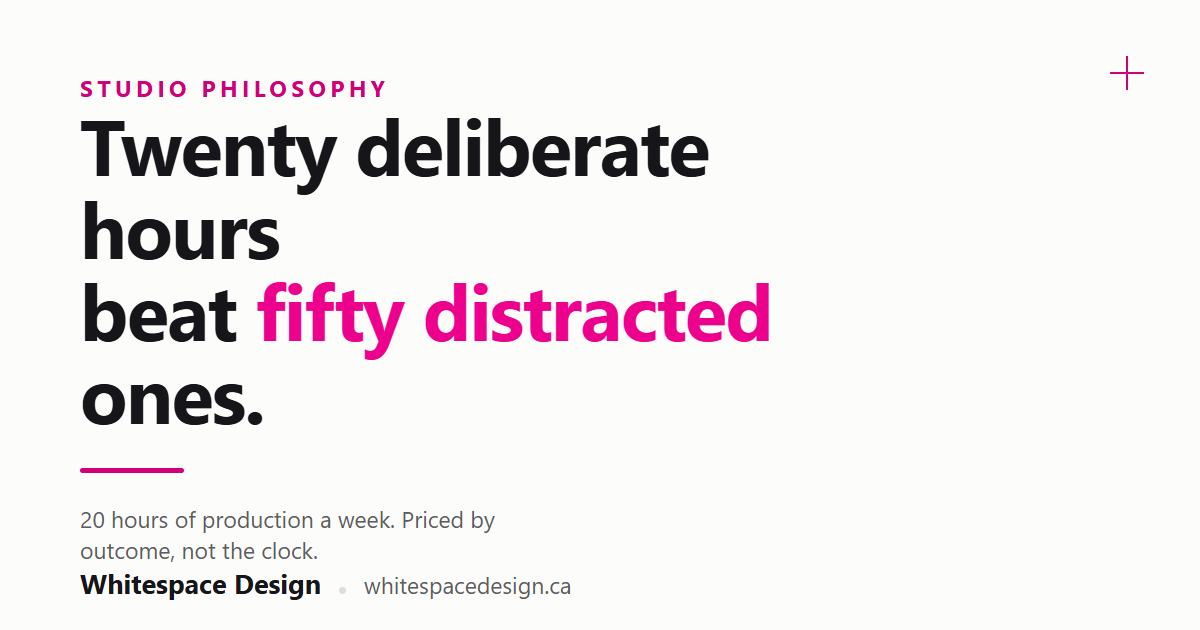
Why 20 hours? Because the work that matters here — a layout, a logo, a brochure that has to survive a trade show table — happens in deep focus, and nobody produces eight hours of that in a day. Twenty deliberate hours beat fifty distracted ones, and the client can tell which one they got.
But how do you run a studio on 20-hour weeks without missing deadlines? You abandon the traditional agency model entirely.
The Secret Weapon: Automation and Asynchronous Work
If you sell your time by the hour, a 20-hour week doesn't work. Instead, Whitespace uses value-based pricing for productized services — a four-page brochure package, a trade show set, a custom automated web deployment. You buy the outcome, not the clock.
The other half is automation:
- The heavy lifting runs overnight. Autonomous coding agents handle the grinding, repetitive parts — boilerplate, test runs, data sorting, asset generation — while I'm offline.
- The human work is direction. I don't start from scratch in the morning. I step in to review what the automation produced, apply the creative decisions it can't make, and fix the logic it got wrong.
- Strictly asynchronous. No endless meetings. Every job is a written brief with a clear definition of "done."
Why "Whitespace"?
In graphic design, white space (or negative space) is the unmarked area between elements. It's the breathing room that makes a design look premium, calm, and deliberate. It implies confidence.
That's exactly what this studio is. Cut out the noise, the overtime, and the bureaucracy, and what's left is the work.
You don't need 50 hours a week to build great systems. You need the right environment and the right tools.